
Can you core drill a post-tension slab?
Yes, in the spaces between tendons, after scanning and after the structural engineer has accepted the centre. Drilling on a guessed grid is not acceptable.

Many Dubai towers and podiums are post-tensioned. The tendons are stressed steel, and the slab was calculated with those forces in place. A core drill that cuts one is not a patching job. It is a structural incident. The drill is still the right tool for a sleeve. It has to land between the cables, on a point someone has accepted.
Ask the structural drawings, not the site rumour. Look for tendon profiles, live-end and dead-end pockets, and notes that say PT or post-tension. If the drawing is missing, assume you need a scan rather than assuming mild steel. Transfer slabs, long spans and thin flat slabs in towers are the usual places this question matters.
Scanning before drilling is how those cables get marked on the concrete. Concrete scanning and the drill should be booked as one sequence.
MEP set-out often puts a pipe on the shortest route. That route may cross a tendon band. The conversation with the engineer is: move the sleeve, or prove this point is clear. Once the mark is accepted, the core drill stays on that mark. A driller should be allowed to stop if the cuttings or the scan do not match what was agreed.
Do not ask the crew to “go carefully” through an unmarked slab. Careful is not a method.
If approval has to leave site, do not book the drill for the same hour as the scan. You will pay for standing time or you will be pressured to drill early.
Photograph the core and the finished hole against the mark. If the sleeve shifts later, the next trade needs to know the slab was drilled where the engineer said, not where the first drawing showed. Fire stopping and the sleeve itself are usually builder’s work unless the quote says otherwise.
Typical diameters for those sleeves are listed in the MEP hole-size guide. Send the PT note with the hole list when you request a quote.
Yes, in the spaces between tendons, after scanning and after the structural engineer has accepted the centre. Drilling on a guessed grid is not acceptable.
The pipe moves, or the engineer designs a way through. The drill crew should not "just avoid the cable" without a marked, agreed point.
The scanning technician marks what the radar shows. The engineer or the main contractor confirms the drill point. The driller follows that mark.
More guides
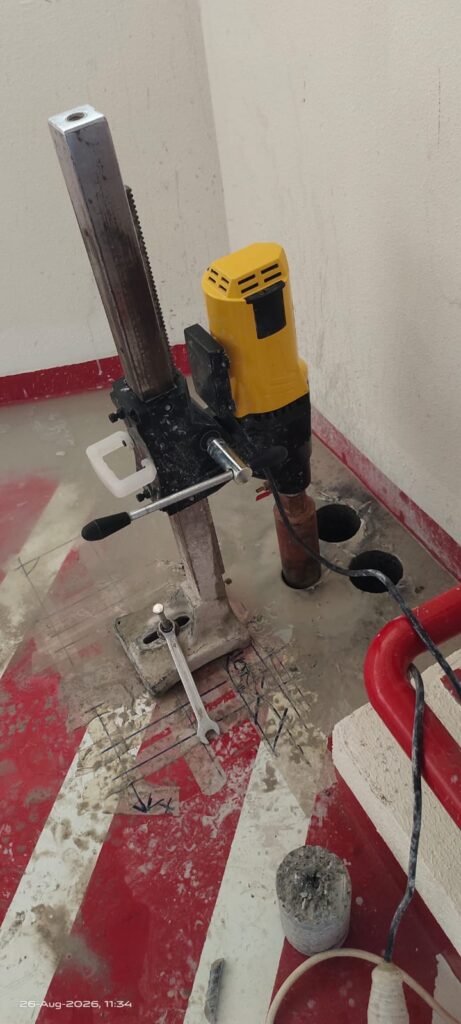
Stitch drilling overlaps round cores to form an opening when a wall saw cannot be mounted. The edge needs more making-good.
Read more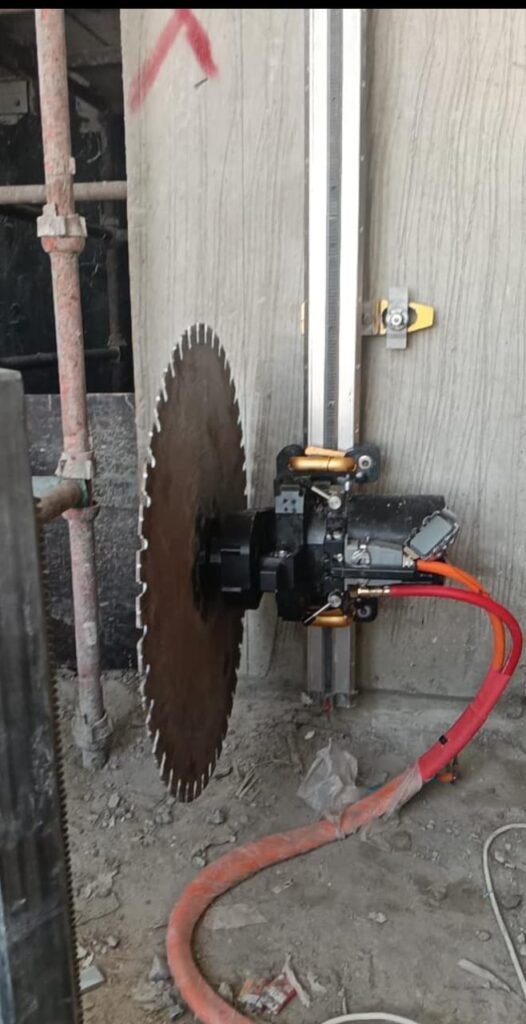
Mark the structural opening, not the frame size alone. A wall saw can then leave a square edge for doors, windows and AC ducts.
Read more
On a live Dubai floor, the cut goes smoothly when water, slurry control, protection below and the set-out are ready before the crew arrives.
Read more