
Do I need scanning for every core hole?
Not for every small hole in a known, lightly reinforced wall. Scan when the slab may be post-tensioned, when drawings are missing, or when a missed service would stop the floor.

Core drilling is a committed cut. Once the barrel is in the slab, you cannot unread what it hits. Concrete scanning is the step that shows rebar, post-tension cables and sometimes conduits before that happens. On Dubai towers it is the difference between a moved mark and a stopped floor.
We treat concrete scanning as part of the same conversation as the drill, not as a separate trade the main contractor has to remember later.
Ground-penetrating radar, used by a technician who reads concrete rather than just a screen, is there to map steel. Ordinary rebar tells you the hole will be slower and the bit will wear. A post-tension tendon tells you the hole may have to move. A live conduit tells you the penetration was drawn through someone else’s service.
The useful output is not a vague “slab is reinforced”. It is marks on the concrete: drill here, do not drill here, and the depth the reading is confident about.
A single 50 mm hole in a block wall with a clear drawing is a different decision. Scanning everything by habit is wasteful. Skipping it on a PT slab is not a saving.
If the consultant must approve the marks, scan first and drill later. If the engineer is on site and can accept a shifted centre, scan and core drilling can be the same mobilisation. Say which one you need when you book, because the second case only works when someone with authority is there to move the mark.
Our note on post-tension slabs covers what to ask the structural engineer before the crew arrives.
Photograph them. Do not let the next trade mop them off. If a centre moves, update the drawing the MEP coordinator is using, or the next floor will be set out from the old point. The driller should be allowed to stop if the cuttings do not match the scan. Pushing on “because the sleeve is already fabricated” is how tendons get cut.
Send the slab type and a photo of the set-out when you ask for a scan and drill quote. If you only need the survey, say that too.
Not for every small hole in a known, lightly reinforced wall. Scan when the slab may be post-tensioned, when drawings are missing, or when a missed service would stop the floor.
Often yes, if the engineer can accept a moved centre the same day. If the report has to go back to the consultant first, book the scan earlier than the drill.
No scan is perfect in heavy steel or deep slabs. It is still the right check before a diamond barrel commits to a line. The driller should stop if the cut does not match the mark.
More guides
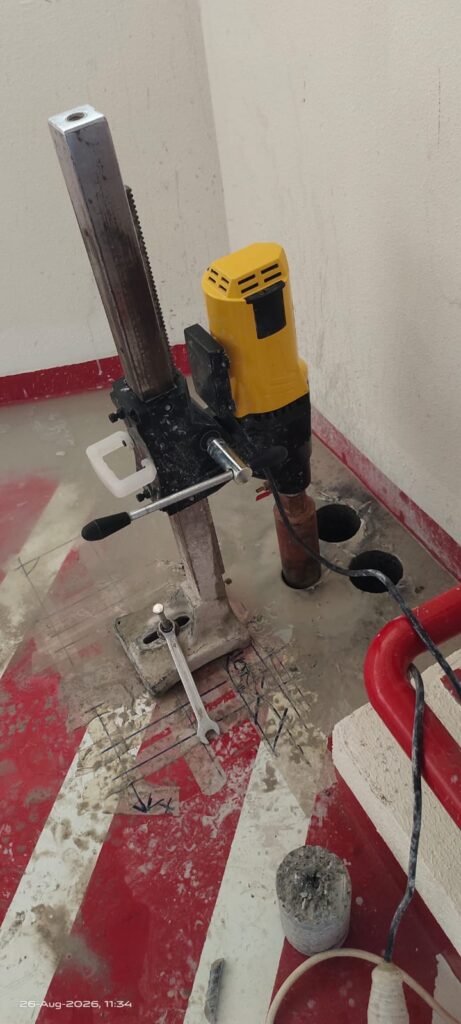
Stitch drilling overlaps round cores to form an opening when a wall saw cannot be mounted. The edge needs more making-good.
Read more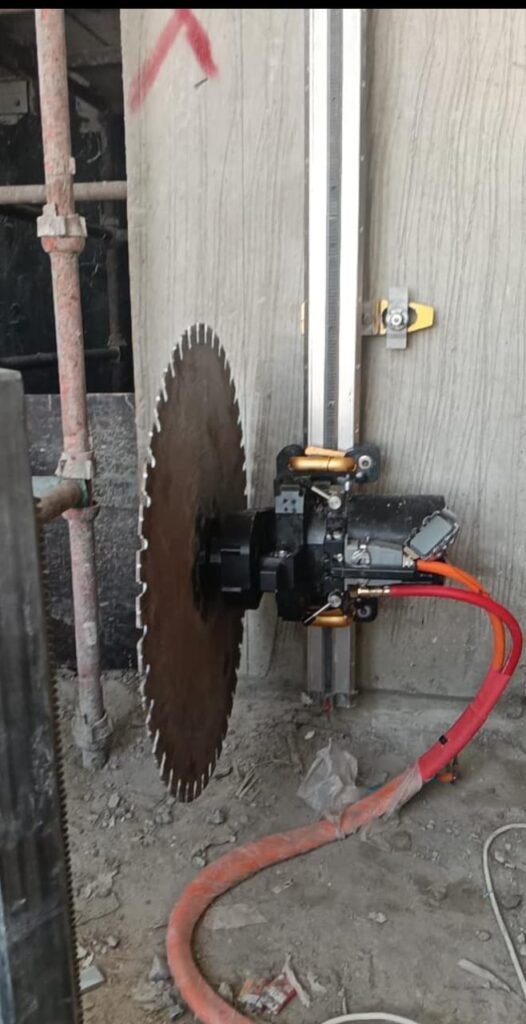
Mark the structural opening, not the frame size alone. A wall saw can then leave a square edge for doors, windows and AC ducts.
Read more
On a live Dubai floor, the cut goes smoothly when water, slurry control, protection below and the set-out are ready before the crew arrives.
Read more