
Can core drilling make a door opening?
Only by stitch-drilling and then breaking the ears, which is slower and rougher. A wall saw is the normal method for a square door or window opening.

Core cutting and wall sawing both use diamond and water. They are not interchangeable. One makes a round hole. The other makes a straight cut. Picking the wrong one is how a door opening turns into a week of making good.
A core drill spins a barrel and leaves a cylinder. That suits pipes, conduits, anchors and test cores. The edge is circular, so a rectangular frame will not sit in it. Diameters follow the service: small electrical sleeves, larger drainage, and occasional large openings that are really a stitch of many cores.
Book core drilling when the drawing shows a diameter. If the drawing shows a width and a height, you are no longer in core-drill territory.
A wall saw runs on a track bolted to the concrete and cuts a straight, plumb line. Doors, windows, HVAC risers and lift-door openings want that edge so the frame sits without a thick pack of mortar. The cut can be full depth in stages, and the piece can be lowered rather than broken in place.
The track needs a sound face to fix to, water, and room for the blade. If the wall is freestanding, badly cracked, or covered in a finish you cannot fix through, say so before the crew arrives.
The stitch-drilling case is common in plant rooms. It is explained in stitch drilling versus a wall saw. Very thick beams are covered in wire sawing versus a wall saw.
A handful of 100 mm cores is often a short visit. A structural door opening needs set-out, track fixing, a cut sequence, and a plan for the lump of concrete that comes out. On a live floor that lump cannot drop. Night work is normal when the opening is in an occupied building.
Mark the opening on the wall, confirm it with the frame size, and check whether the engineer has accepted the cut. Then send the photo. Door and duct openings are spelled out in the openings guide.
If you are unsure which crew to book, send the drawing to the quote desk. The method should be named in the reply, not left as “cutting”.
Only by stitch-drilling and then breaking the ears, which is slower and rougher. A wall saw is the normal method for a square door or window opening.
No. Round penetrations are core drilled. If you need both a door and a row of sleeves, book both methods instead of forcing one.
Then stitch drilling is the fallback. It needs more holes and more making-good. See the stitch-drilling guide before you promise a square edge.
More guides
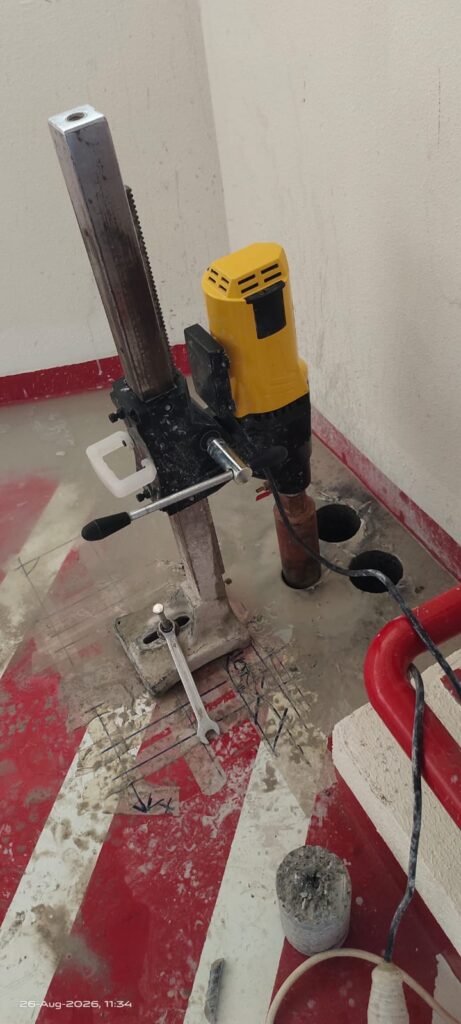
Stitch drilling overlaps round cores to form an opening when a wall saw cannot be mounted. The edge needs more making-good.
Read more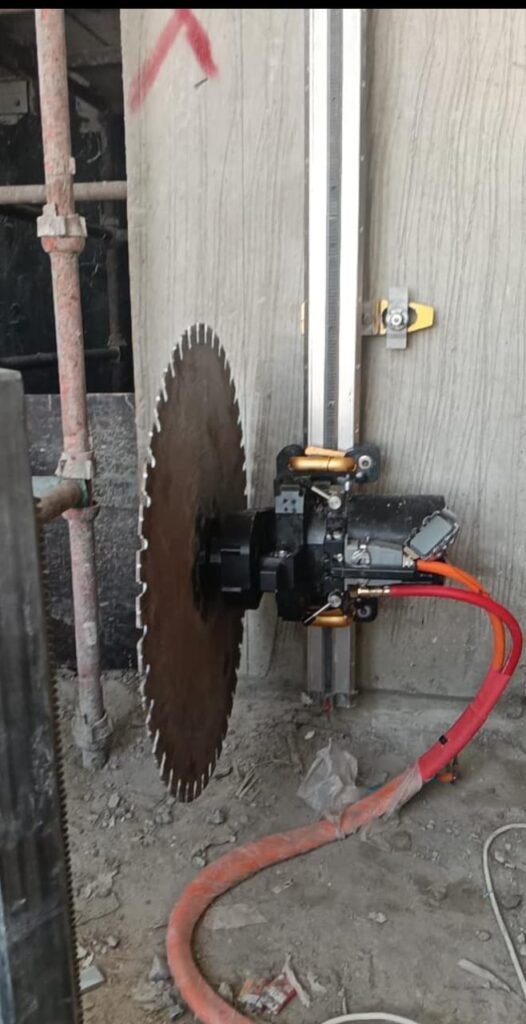
Mark the structural opening, not the frame size alone. A wall saw can then leave a square edge for doors, windows and AC ducts.
Read more
On a live Dubai floor, the cut goes smoothly when water, slurry control, protection below and the set-out are ready before the crew arrives.
Read more