
Is wire sawing only for demolition?
No. It is also used to release a thick beam, a pile cap or a machine base where a wall saw cannot reach, including on alteration jobs.

A wall saw is the default for a straight opening in a wall. It stops being the right tool when the concrete is thicker than the blade can pass, or when there is no face to bolt a track to. That is the usual moment to change to wire sawing.
A wall saw needs a sound surface, anchors for the track, water, and clearance for the blade guard. It cuts a flat plane. Doors, windows and ducts are its work, and the comparison with round holes is in wall sawing versus core cutting.
If the section is a deep beam, a pile cap, a bridge pier or a foundation thicker than the largest blade you can safely run, more passes from both sides still may not meet. Forcing it leaves a web of uncut concrete in the middle.
Wire sawing threads a diamond wire around or through the section and pulls it through on pulleys. The cut can be very deep. It can work where a circular blade has no swing. Setup is slower: the wire path, the anchors and the direction the offcut will move all have to be planned before the motor starts.
It is the method we use for thick RCC that a track saw cannot finish. It is also used when a piece must be freed and lifted rather than broken, because breaking a heavy section on a live structure is how cracks travel.
Weight matters as much as thickness. A “small” opening in a transfer beam can still be a crane or a gantry problem. If the quote does not say how the piece leaves, it is not finished.
Photos of all sides, the thickness if you know it, and what the section is holding up. If drawings exist, the beam size is more useful than a wide shot of the site. Tell us whether the building is occupied and whether a method statement has to go to the consultant first.
Partial villa and structural removals that end up on a wire are discussed in the villa demolition briefing. For a first look, use the quote page and say “wire or wall” if you are unsure. We would rather name the method than arrive with the wrong saw.
No. It is also used to release a thick beam, a pile cap or a machine base where a wall saw cannot reach, including on alteration jobs.
Only if the blade diameter and access allow a full pass, often from more than one side. Past a certain thickness, wire is the honest method.
Yes. It is still a structural cut and still needs an agreed sequence, exclusion zone and a plan for the piece that comes free.
More guides
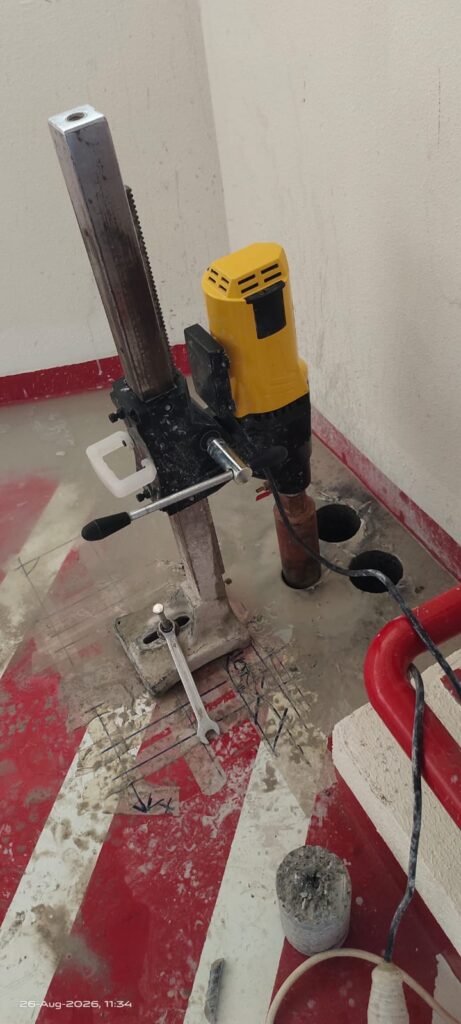
Stitch drilling overlaps round cores to form an opening when a wall saw cannot be mounted. The edge needs more making-good.
Read more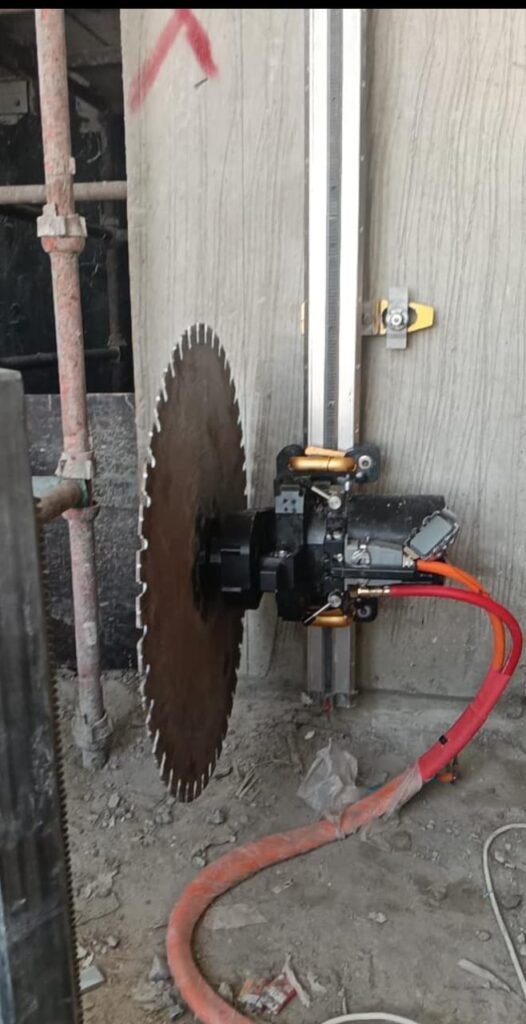
Mark the structural opening, not the frame size alone. A wall saw can then leave a square edge for doors, windows and AC ducts.
Read more
On a live Dubai floor, the cut goes smoothly when water, slurry control, protection below and the set-out are ready before the crew arrives.
Read more